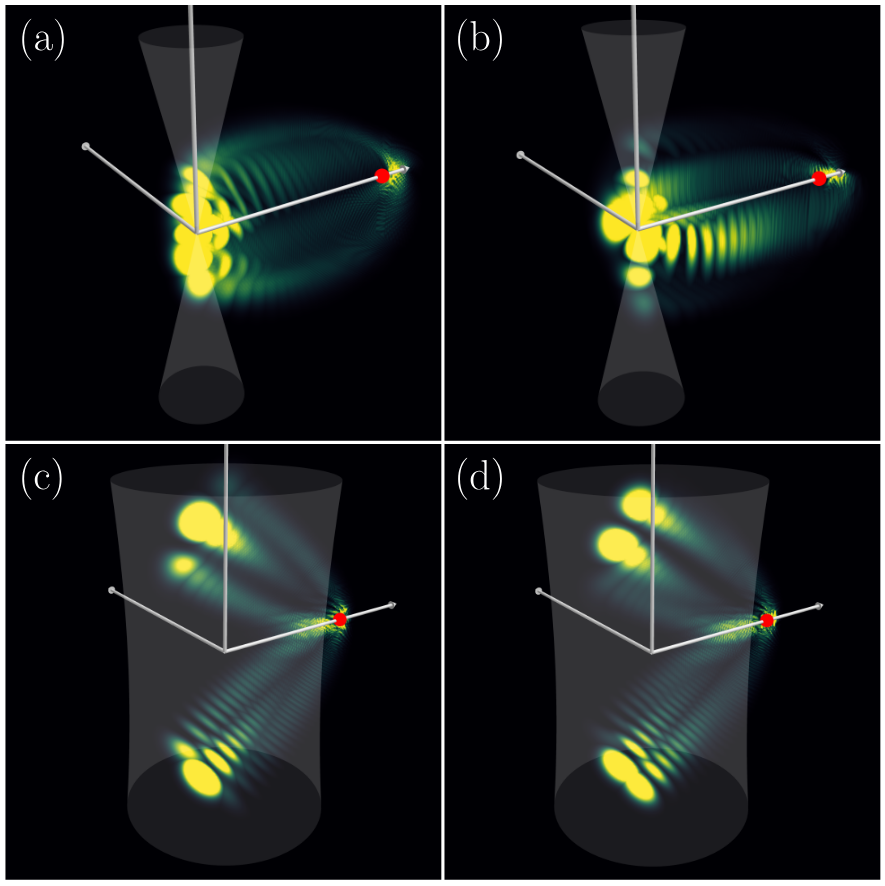
Electronic orbitals are central to our understanding of how matter is built up from atoms over molecules to solids. Controlling these orbitals locally is a challenging task which typically requires atomic-scale resolution instruments such as tunneling or atomic force microscopes. However, electronic orbitals need not remain microscopic: in Rydberg atoms, the size of the electronic wave function can extend up to a few micrometers. This opens an entirely different approach for the local manipulation of electron orbitals using strongly focused laser beams.
In a new preprint together with colleagues from the MPIPKS Dresden and Purdue University, we propose such local manipulation and spatio-temporal sculpting of the electronic matter wave of a Rydberg atom by a laser field focused so that its beam width is smaller than the Rydberg electron orbit. We compute the new quantum mechanical wavefunctions in the presence of the sharply focused laser beam, and find new electron orbitals which exhibit very large kilo-Debye dipole moments. These can be even modulated in time with high bandwidth by the local tweezer intensity, forming an atomic-scale Hertzian dipole. The tweezer can also be used to trap the Rydberg atom in an eccentric way by “grabing” the electronic wavefunction.